Liquid soil products for civil engineering, pipeline construction, and excavation sites
What is liquid soil?
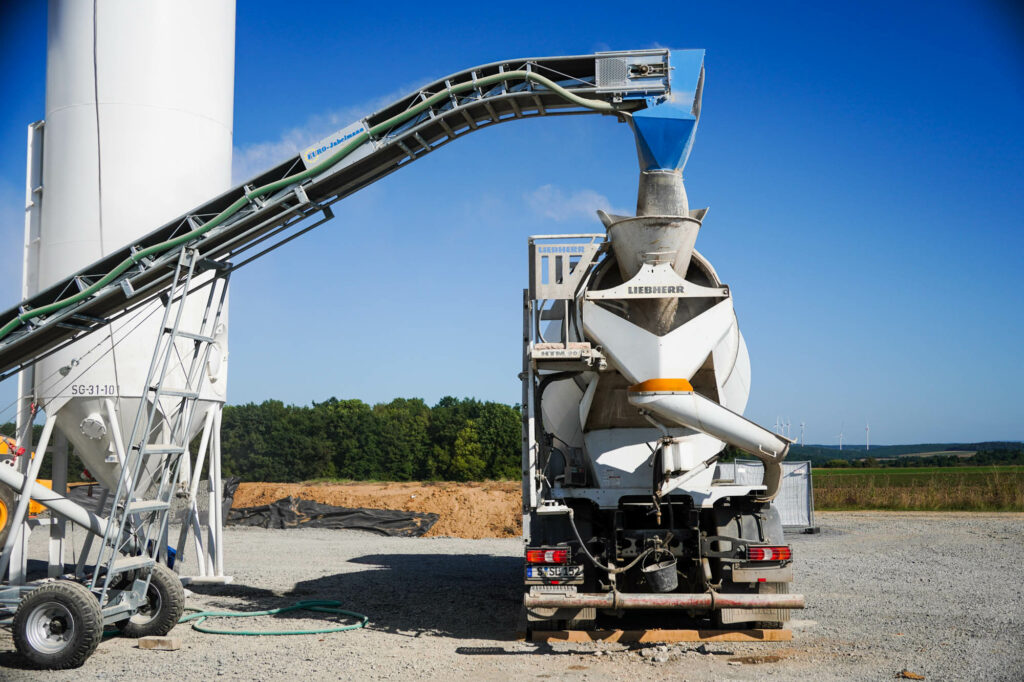
Liquid soil belongs to the ZFSV group (temporarily flowable, self-compacting backfill materials) and is a construction material consisting of soil mixed with binders, additives, and water; it is used primarily for backfilling in areas that are difficult to access or compact. The liquid soil material flows with virtually no additional compaction energy and completely fills voids and gaps.
As a backfill material, liquid soil offers numerous advantages over conventional layer-by-layer backfilling, hydraulically bound water suspensions, or concrete: Liquid soil is highly versatile due to the ability to precisely adjust the required soil mechanical properties (e.g., ease of excavation, high load-bearing capacity under foundations, etc.). Application-specific formulation properties, such as thermal conductivity, water impermeability, or pollutant binding, offer endless possibilities for use.
An Overview of Our Liquid Floor Products
Standard Liquid Floor
for traditional utility trenches and excavation pits
Thermally Conductive Liquid Substrate
for district heating and energy projects
Liquid soil for contaminant binding
for contaminated soil
Project-Specific Custom Formulations
customized to meet specific requirements
Soil backfilling in civil engineering using liquid soil
Liquid soil is particularly suitable for backfilling in civil engineering projects where utility trenches, excavation pits, shafts, or hard-to-reach areas need to be filled safely and evenly. The material is flowable and self-compacting during installation, ensuring that voids and gaps are reliably filled.
Liquid soil can be an efficient alternative to traditional backfill material, particularly in pipeline construction, sewer construction, district heating lines, and inner-city infrastructure projects. It reduces the need for compaction work, shortens construction times, and makes it easier to control the quality of the backfill.
For more information on possible applications , please visit our Services page .
Manufacture and Production of Liquid Soil
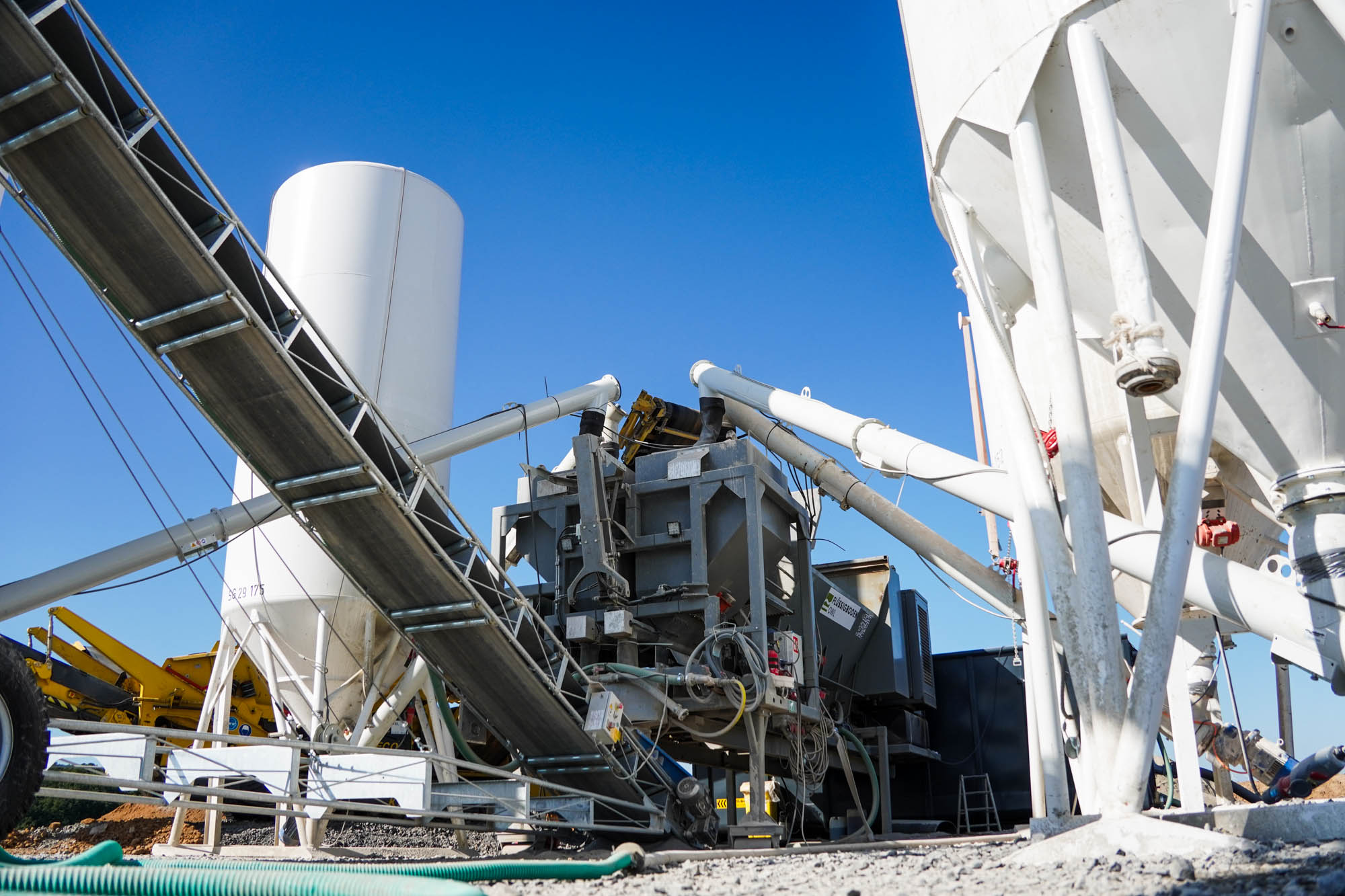
Our production process is designed to accommodate flexible construction site operations, high productivity, and consistent quality. Depending on the project requirements, we utilize various mixing plant options to ensure that liquid soil can be produced efficiently and tailored to the specific conditions of each construction site.
- Production capacity of up to 100 m³ per hour
- Economically optimized machinery
- Flexible, modular, and efficient
- Two system options: an electric-powered mixing system (suitable for cleanrooms, among other applications) and a diesel-powered mixing system
- Digital Monitoring of Mixing Plants for Process Optimization
- Time- and cost-efficient construction site logistics
- Environmentally Friendly Construction Process
- A well-coordinated construction crew
- Digital Delivery Note Program
Benefits of Our Liquid Floor Products

Complete flexibility

Increased efficiency

Reduced costs

Highest quality

Reduced risks

Environmentally friendly
Comparison of Our Mixing System Options
We have a variety of mixing systems available for the production of our liquid floor products. Depending on the site conditions, production volume, and environmental regulations, we select the most suitable system option.
Our proprietary mixing plant technology is based on a mobile machine configuration that can be flexibly adapted to any construction site situation, ensuring optimized site layout throughout Germany and Europe. In accordance with operational requirements, we set up and operate every construction site with economic and environmental considerations in mind. Digitized monitoring processes support the efficient operation of our plants. Depending on the specific requirements of the construction site (nature conservation regulations to be observed, geological conditions of the site, project-specific handling of hazardous substances in the soil, etc.), we provide either electric- or diesel-powered plant technology.
| System with a diesel engine and hydraulic system | System with an electric motor | |
|---|---|---|
|
Hourly production capacity:
|
up to 100 m³
|
up to 100 m³
|
|
Setup and preparation time:
|
approx. 3 hours, including silos
|
approx. 3 hours, including silos
|
|
Base dimensions:
|
12 x 12 m
|
12 x 12 m
|
|
Floor stability:
|
Compacted gravel base course or at least equivalent
|
Compacted gravel base course or at least equivalent
|
|
Special feature:
|
Self-sufficient use
|
Can be used in nature reserves and water protection areas, as no drive or hydraulic fluids are used
|
|
Energy consumption per cubic meter:
|
about 0.5 liters of diesel
|
approx. 0.75 kWh
|
Would you like to know which system solution is right for your project? Contact us — we’d be happy to advise you personally.
Which system option is right for your project?
The best system option for your project depends on the site conditions, environmental regulations, the required production volume, and the specifications for the liquid soil. The system with a diesel engine and hydraulic drive offers advantages for self-sufficient construction sites, while the system with an electric motor is particularly suitable for sensitive applications such as nature reserves and water protection areas.
Together, we will determine which solution is the best fit for your construction project in terms of cost-effectiveness, technical feasibility, and environmental impact.
Liquid foundation for district heating pipelines and pipeline construction
When installing district heating and utility lines, a backfill material is needed that securely encloses the pipes, reliably fills voids, and provides a stable foundation. Liquid soil can be an efficient solution here, as it is installed in a fluid state and spreads evenly around the pipes.
Liquid soil offers advantages over traditional backfilling, particularly in narrow utility trenches, inner-city construction sites, and challenging route alignments. Installation can be carried out more quickly, cleanly, and with greater precision.
Quality Assurance for Our Liquid Floor Products
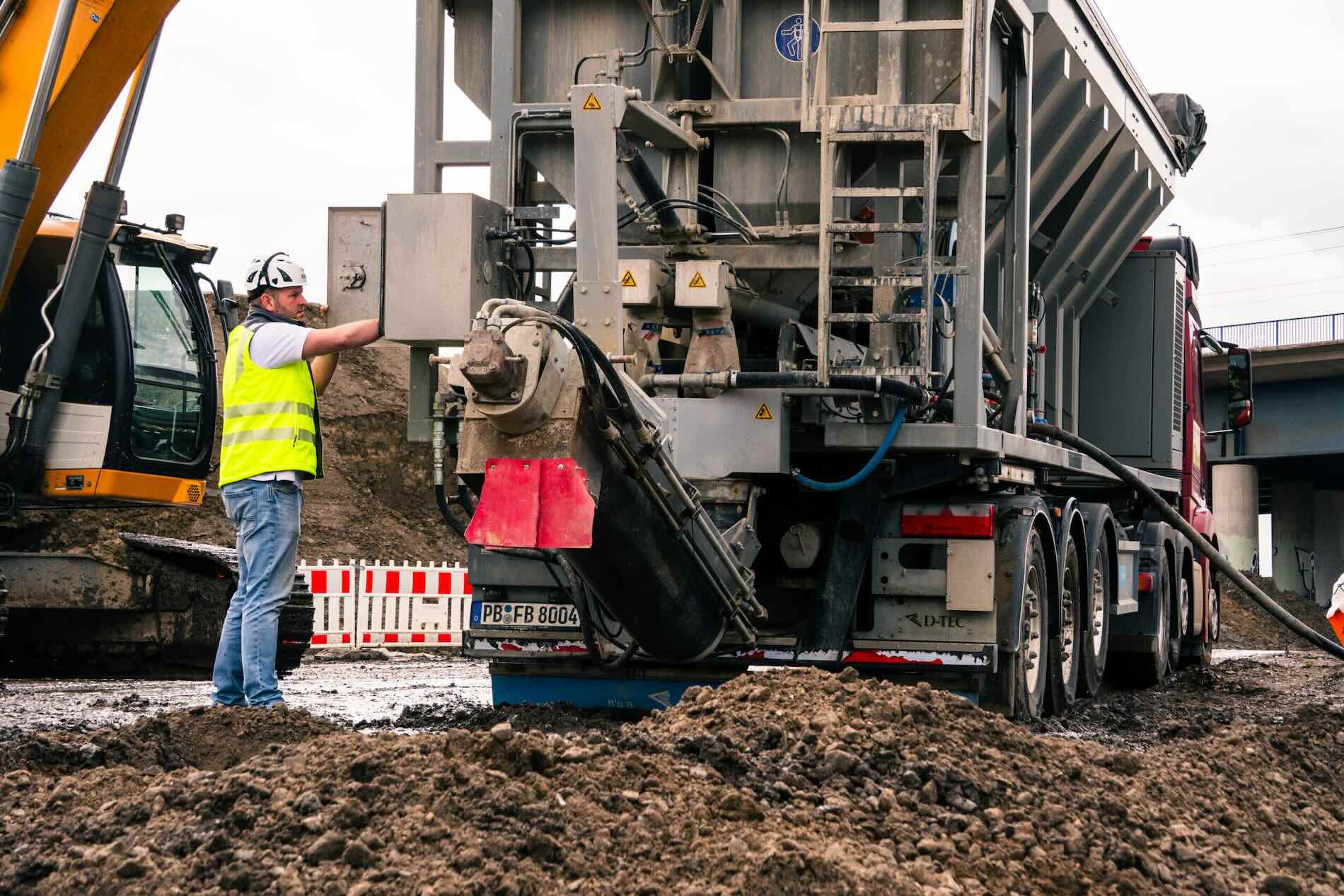
Controlled quality assurance is crucial in the production and installation of liquid flooring. The formulation, material properties, and production processes are tailored to the specific requirements of each project.
Through internal and external oversight, digital monitoring, and a digital delivery note system, the manufacturing, delivery, and installation processes are documented in a traceable manner. This provides peace of mind for construction companies, clients, and project stakeholders.
Applications for our liquid floor products
Utility Line Construction
Liquid soil is suitable for backfilling utility trenches and pipelines. It evenly coats the pipes and provides a stable, low-settlement bedding.
Canal Construction
In sewer construction, liquid soil reliably fills voids and enables the secure backfilling of sewers, manholes, and connection areas.
District heating pipes
In district heating systems, liquid grout protects the pipes and can be tailored to meet technical requirements through project-specific formulations.
Excavations
In excavation pits and work areas, liquid soil ensures uniform backfilling without the need for time-consuming compaction work and reduces subsequent settlement.
Cavity Filling
Liquid floor spreads on its own in hard-to-reach areas and is ideal for completely filling cavities and gaps.
Infrastructure Projects
Whether it's road construction, utility lines, or municipal construction projects—liquid soil supports cost-effective, sustainable, and efficient construction processes.
Frequently Asked Questions About Our Liquid Floor Products
Fluidized soil is a self-compacting backfill material that is temporarily flowable. It is made from soil, water, binders, and additives, and can be specifically tailored to the requirements of a construction project. This makes it particularly suitable for civil engineering, pipeline construction, excavation pits, and cavity backfilling.
In civil engineering, liquid soil is primarily used to backfill utility trenches, construction pits, shafts, cavities, and hard-to-reach areas. Liquid soil offers an efficient alternative to traditional backfill materials, particularly in utility line construction, sewer construction, and infrastructure projects.
In pipeline construction, liquid soil evenly surrounds the pipes and reliably fills voids. This reduces the need for compaction work, shortens construction times, and minimizes the risk of settlement or damage to the pipes.
Every construction project places different demands on the building material. That is why Flüssigboden OWL develops a custom formula for each job site. Factors such as soil type, moisture content, installation conditions, and the desired material properties are taken into account. The result is a liquid soil that is optimally tailored to your construction project.
A mobile liquid soil mixing plant is used when liquid soil needs to be produced directly on or near the construction site. This is particularly useful for large civil engineering projects, pipeline construction, district heating pipelines, or infrastructure projects with high material requirements.
Yes, fluidized soil is well-suited for district heating pipelines. Thanks to its flowable and self-compacting properties, it spreads evenly around the pipes and ensures stable backfilling of the trench. This can be a major advantage, especially in tight spaces and on inner-city construction sites.
Yes. Fluid soil is particularly well-suited for filling voids beneath structures, traffic areas, or in hard-to-reach areas. Thanks to its flowable properties, even complex voids are completely filled and permanently stabilized.
Under certain conditions, it is possible to determine whether contaminated excavated soil can be treated with a project-specific liquid soil formulation and reused. Technical suitability is verified through soil analyses and laboratory tests.
Are you planning a construction project and want to find out if liquid soil is the right solution? Our team will advise you every step of the way—from your initial inquiry, through selecting the appropriate formula, to implementation on the job site. Together, we’ll find the best solution for your project.
Planning a liquid floor project? We’d be happy to advise you